Malik Abdul Jabbar
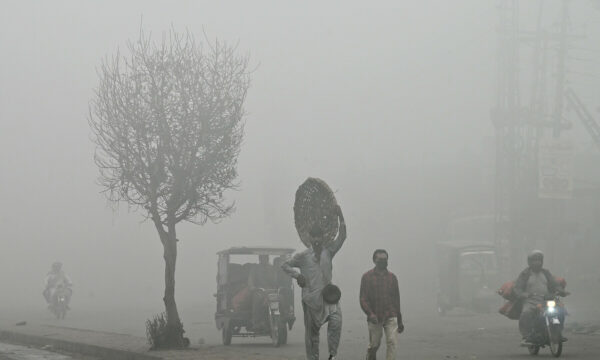
LAHORE;Lahore topped the list of the world’s most polluted major cities once again on Sunday morning with an hourly air quality index (AQI) reading of over 500, according to real-time air quality data.
Swiss air quality monitoring platform IQAir’s live global major city ranking placed Lahore at the top at 538 between 9am and 10am, classifying the quality as ‘hazardous’, indicating extremely polluted conditions and serious health risks for residents.
It was followed by Delhi with an AQI of 207, Karachi with 180, Mumbai with 177 and Cairo at 162. The ranking showed Lahore’s pollution level to be more than twice that of the second-ranked city, Delhi.
The deterioration was not confined to the provincial capital.
IQAir’s live ranking of Pakistani cities on Sunday morning placed eight Punjab cities among the country’s 10 most polluted urban centres.
Kahna Nau in Lahore district topped the list with an AQI of 606, followed by Lahore at 538, Bahawalpur at 536, Sargodha at 392 and Gujranwala at 347.
Other cities in the top 10 included Multan, Dera Ghazi Khan, Skardu, Faisalabad and Peshawar.
According to global health statistics, air pollution, both outdoor and indoor, is the second-leading risk factor for deaths worldwide, claiming an estimated 8.1 million lives annually. Outdoor particulate matter alone accounts for 4.7m deaths.
Lahore has consistently ranked as the world’s most polluted major city in the past few weeks. On Saturday evening, it recorded an AQI of 266, showing Lahore’s air quality in the hazardous category.
On Friday, heavy smog pushed air quality in several Punjab cities into the hazardous category, with Lahore recording an hourly AQI reading of 465 between 7am and 8am.
The persistent deterioration in air quality comes despite the Punjab government’s ongoing anti-smog measures, with Lahore Traffic Police claiming to have intensified enforcement operations against vehicles contributing to air pollution.
Chief Traffic Officer Syed Abdul Rahim Shirazi on Saturday claimed that the traffic police have issued challan tickets to 14,653 smoke-emitting vehicles.
Action has also been taken against 10,306 vehicles transporting sand, soil and other materials without covering their loads with tarpaulins.
The police have also proceeded against 31,618 unfit and dilapidated vehicles and taken action against 272,760 vehicles for overloading, he said.
Meanwhile, earlier this week, according to the Punjab Environment Protection and Climate Change department, enforcement teams conducted 84,370 inspections of brick kilns across the province between Jan 1 and Nov 18, demolishing 1,429 units, sealing 968 and registering 1,248 FIRs against violators.
During the critical smog period from Sept 1 to Nov 18, the department conducted 29,999 visits, demolished 519 kilns, sealed 494 and registered 408 FIRs, besides imposing fines totalling Rs101.45m.
Pakistan’s average PM2.5 concentration stood at 67.3 micrograms per cubic metre in 2025, nearly 14 times the World Health Organisation’s annual guideline of 5 micrograms per cubic metre, according to the 2025 World Air Quality Report.
This concentration corresponded to an average AQI of 156, placing Pakistan among the world’s most polluted countries.