Malik Abdul Jabbar
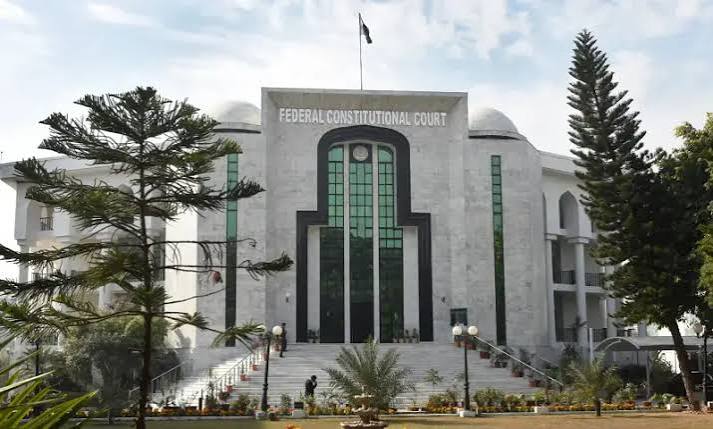
Islamabad(newsviews) Expressing concern over a delay of around 40 years in a case relating to land consolidation proceedings and its adverse implications for the proprietary rights of landowners, the Federal Constitutional Court (FCC) on Thursday issued guiding principles for revenue authorities, particularly the Punjab Board of Revenue, to prevent protracted litigation.
“Consolidation proceedings should be concluded expeditiously, within prescribed statutory timelines or within a reasonable period,” observed FCC Chief Justice Aminuddin Khan.
The chief justice was heading a two-judge bench, also comprising Justice Ali Baqar Najafi, which, on a civil petition filed by Khaliqus Zaman, overturned the Lahore High Court’s (LHC) Rawalpindi Bench order of Sept 26, 2024, remanding the matter to the revenue authority.
Through its initial order, the high court had disposed of the writ petition through a consent order, which was later modified. During the hearing before the FCC, the petitioner’s counsel argued that the LHC order was not a consent order, referring to a subsequent LHC order dated Nov 18, 2024, which rectified the original judgement by deleting the sentence “learned counsel for the respondents have no objection in this regard”.
The FCC observed that, with the consent-related portion of the order removed, “the question of consent no longer arises”.
The case originated from land consolidation proceedings initiated in 1979 but remained mired in administrative and judicial appeals for over four decades.
The record revealed that proceedings had remained embroiled in successive administrative and judicial issues for several decades. The chief justice regretted that such protracted litigation defeated the very purpose of consolidation, namely, the rationalisation of landholdings and certainty of proprietary rights.
Prolonged administrative inaction not only perpetuated uncertainty regarding ownership and possession but also caused financial hardship and led to multiple rounds of litigation, the FCC observed. It emphasised the need for revenue authorities to discharge their statutory obligations diligently, fairly and expeditiously, ensuring that valuable property rights protected under Article 23 of the Constitution were not rendered illusory by unwarranted delays.
The FCC observed that the LHC, instead of adjudicating the matter on merit and examining the documentary evidence, had wrongly referred the case back to the revenue hierarchy.
Since the high court had neither decided the petition on merit nor considered that its earlier order of Sept 26, 2024, had already been implemented by the revenue authorities, referring the matter back to the revenue hierarchy for consolidation purposes was not sustainable under the law.
While concluding the proceedings, the FCC issued guiding principles requiring revenue authorities to avoid unnecessary adjournments and administrative delays, with reasons for any unavoidable delays to be recorded.
It further directed that affected parties be afforded a fair opportunity of hearing and that all determinations be based on the relevant record and supported by cogent reasons.
Likewise, orders that had attained lawful finality should not be reopened except under express statutory authority, while binding judicial directions should be implemented promptly.
The guidelines also called for discouraging repetitive remands and successive proceedings to prevent multiple rounds of litigation. The senior member of the Board of Revenue Punjab was directed to ensure effective supervision, timely disposal of longstanding cases and accountability for unjustified delays, strictly in accordance with the law.